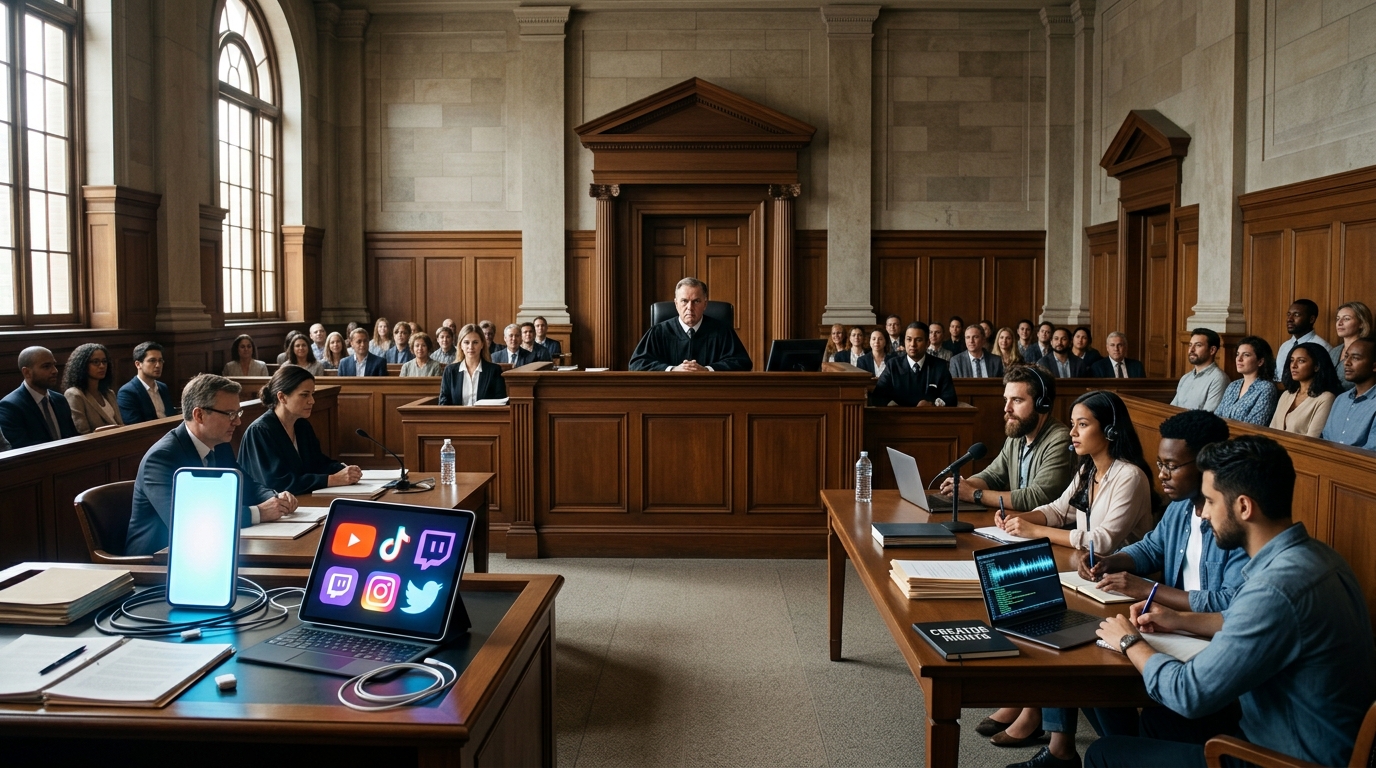
Somewhere in the discovery phase of at least three separate class-action lawsuits, attorneys are currently arguing that YouTube, TikTok, and Twitch function as employers — that the platforms control creators' working conditions, set their compensation formulas, dictate content standards, and can terminate their income without warning, which is a description so accurate it's almost flattering to include in a legal filing.
The lawsuits vary in their specifics, but the core argument is the same across all three: when a platform controls how much you earn, what you're allowed to create, who can see your work, and what happens to your livelihood if you violate their terms (which can change at any time, for any reason, with a blog post and two weeks' notice), that starts to look a lot less like a hosting arrangement and a lot more like employment — without any of the legal protections employment actually provides.
No overtime pay. No unemployment benefits if the algorithm decides to quietly bury your content. No recourse when the monetization policy changes and your ad revenue drops forty percent in a month. No HR department to call when a strike targets your channel and Twitch Support sends you an auto-reply.
What the Lawsuits Are Actually Claiming
The legal theory runs through something called “economic reality” tests — the same frameworks courts have used to determine whether gig workers are employees or independent contractors, which is a fight that has been happening in courtrooms and state legislatures for a decade now and has not reached anything resembling a stable resolution. The question isn't whether you signed a contract that says “independent creator” (you did; they all say that). The question is whether the actual economic relationship resembles employment regardless of what the contract says.
Courts look at things like: Does the company control the manner and means of your work? Are you economically dependent on this entity for the majority of your income? Does the company set the rate of pay unilaterally? Can they terminate the relationship without cause? The answer to all four of those questions, for a creator who has built their livelihood inside a single platform's ecosystem, is almost always yes, yes, yes, and yes.
The platforms will argue, correctly, that creators set their own hours, own their intellectual property (technically), and can post wherever they like. Creators' attorneys will argue that the economic reality — that most full-time YouTube creators earn the overwhelming majority of their income from YouTube-controlled revenue streams, subject to YouTube-controlled rules, distributed by YouTube-controlled algorithms — makes those freedoms largely theoretical. Both sides have a point, which is why this is going to take years to resolve, and why the outcome is genuinely uncertain.
The FTC disclosure enforcement angle sits just underneath all of this, too: as regulators increasingly scrutinize whether creators are properly disclosing paid relationships, the question of what a “creator” actually is — independent contractor, employee, something else entirely — becomes more than academic. The answer affects whose rules you're playing by and who bears responsibility when those rules aren't followed.
The Part Creators Don't Want to Look at Directly
Here is the uncomfortable thing about these lawsuits: the legal framing is novel, but the underlying reality isn't. Most full-time creators already ARE economically dependent on one platform in ways that would, in any other industry, be recognized immediately as a significant structural risk.
A content creator who earns ninety percent of their revenue from YouTube ad share, has built their entire audience on YouTube's subscriber system, and has no meaningful way to contact or reach those subscribers outside the platform — that person is not running an independent business. They are running a division of YouTube that YouTube hasn't gotten around to formally recognizing. The distinction matters a great deal until it suddenly doesn't, which is usually the moment the algorithm changes or the monetization policy updates or the platform decides their content category is now demonetized.
I've watched this happen to TikTok creators whose entire income evaporated when the Creator Fund was restructured. I've watched it happen to Twitch streamers when the exclusivity terms changed and they were left choosing between a worse deal and starting over. The lawsuits are a legal articulation of a business problem that predates the lawsuits by years, and the creators most at risk are not the ones who are going to win in court — they're the ones who are still, right now, operating as if one platform's continued goodwill is a business model.
What This Has to Do With Tonimus
I'm not going to tell you Tonimus will protect you from a lawsuit or that we have anything to do with employment law. We don't, and anyone who tells you their SaaS platform is a legal strategy is selling something.
What I will tell you is that the risk these lawsuits are pointing at — total economic dependence on a single platform that controls your income, your audience, and your ability to operate — is a real risk, and the structural response to it is diversification. Publish on YouTube AND publish somewhere you own the relationship with your audience. Build revenue streams that don't all flow through the same algorithm. Track your content performance across platforms so you know, with actual data, where your income is coming from and what it would look like if one of those sources disappeared tomorrow.
That's what Tonimus is built to do. Not because lawsuits, but because platform dependency is a business problem with a business solution, and the solution is not to hope your platform stays friendly — it's to make yourself less dependent on any single platform's continued goodwill. We help you manage your content pipeline across channels, track revenue across sources, and build the kind of distributed presence that means no single algorithm owns you.
The courts are slowly, expensively, in multiple jurisdictions, figuring out what creators already know intuitively: the relationship between platforms and the people who build their value is not what the terms of service say it is. You don't have to wait for a ruling to act on that information. The answer isn't litigation — it's not being in a position where one platform's decision determines whether your business survives.
Own your audience. Diversify your channels. Know your numbers. The rest is commentary.
Tonimus tracks your content performance and revenue across platforms, so you can see exactly where your business stands — and what it looks like if one channel goes sideways. We're in private beta — apply for early access.